-->

How much sleep do you actually need to work productively?


Wana know : How much sleep do you actually need to work productively?
Could less than seven hours of shuteye be enough to keep our bodies and brains in tip-top shape? Discover the answer in the new episode of AsapSCIENCE.


We all spend about 24 years of our lives sleeping, and although the exact function of sleep is still being debated by science, one or two sleepless nights are enough to make us feel groggy and anxious.
But how many hours of shuteye do we need really every night to make sure we always feel refreshed?
According to the latest episode of AsapSCIENCE, scientists monitored the sleeping habits of three groups of volunteers. One group slept four hours every night for 14 days; the second got six hours of rest, and the third, eight.
After only a couple of weeks, the volunteers in the six-hour group exhibited reaction times similar to those of people who have a blood alcohol level of 0.1 percent, as well as a steady decline in their brain function. Some of them even dozed off during the study’s assessment session.
If you only get four to six hours of sleep a day, could a few night of good sleep help you feel better? Discover the answer in the latest episode of AsapSCIENCE.
Source: AsapSCIENCE

On Your Side: Samsung cell phone fire


On Your Side: Samsung cell phone fire

A 13-year-old North Texas girl was awoken in the night by a smoldering cell phone on the other side of her pillow, but the cell phone manufacturer says she did something they warn users about.

A spokesperson for Samsung says their products are safe, and pointed out that the battery inside the phone was a replacement unit and not an original Samsung part.

the company does agree there is a need for consumer education when it comes to rechargeable batteries. That’s exactly why they post a warning in their user guide, which specifically states covering one of their devices with bedding or other material could restrict airflow and cause a fire.


Don't let this be you! Read the full story here --- --->
http://www.myfoxhouston.com/story/26109226/on-your-side-samsung-cell-phone-fire

image source : .myfoxhouston.com

ATM Frauds and Solutions

ATM Frauds and Solutions


ATM FRAUDS In general ATM fraud can include any deliberate 'criminal' technique which involves the use of an ATM to obtain something of value. Attacks against ATMs may be classified as ATM physical attacks and ATM fraud.

    Growing ATM Threats

    • More than 70 percent of financial institutions experienced an increase in ATM/debit card fraud claims in 2011
    • The U.S. Secret Service reports $8.5B in annual U.S. credit card fraud losses, including ATM skimming.
    • Ram raids are those threats when criminals physically break out ATMs from the wall at the institution.
    • Criminals go through the financial institution's telephone banking service to change PIN numbers.. 

    Types of ATM Frauds 

    • Card Theft 
    • PIN Compromise 
    • Card Skimming 
    • Cash Trapping 
    • Transaction Reversal 
    • Deposit Fraud. 

    What is ATM Skimming 

    • ATM skimming Device card reader which can be disguised to look like a part of the machine. The card reader saves the users' card number and pin code, which is then replicated into a counterfeit copy for theft. 
    • It help criminials in
       a) Knowing Account information 
       b) Pin compromise 
    • ATM card entry slot skimmers have various shapes and sizes


    How PIN is Compromised
     • Its obtaining debit card information by unauthorized individual. 
    • Shoulder surfing or using use of a miniature camera. 
    • Video surveillance 
    • Hidden video camera 
    • Overhead cell phone camera 
    • Remotely positioned cameras 
    • PIN pad overlay


    ATM System Attacks 
    • Criminal attempts to penetrate ATM network, violate confidentiality, integrity, and/or authenticity of transaction data. 
    • Malicious software (i.e., viruses, worms, Trojans, rootkits, etc.) installed on ATM’s computer systems


How to avoid ATM Frauds 
• Fraud Prevetion 
• Physical Protection 
• System Security
• Intellegent Monitoring 
• Consultancy 
• Consumer Safety

Fraud Prevetnion 
• Shield your hand when you enter in your PIN 
• Ensure that no one is peeking or shoulder surfing while you are entering PIN. 
• Avoid using ATMs in isolated locations 
• Always prefer ATM machines near Bank Branch.
ATM Skimming • Never follow a link in a bank email notice if you find it suspicious. visit your banks website and search for latest updates. 
• Examine the ATM equipment carefully for any skimming devices. • Look for 'extra' cameras other than general ATM security camera. 
• Check the ATM card Slot properly before using it. 

NEVER EVER RELY ON UNKNOWN PERSON
• Use of Up-to-date Technology 
• Security CCTV Cameras 
• Alarm Clock 
• Safe and locks 
• Video monitors in junction with sensors. 
• Ensuring Best Location for ATM deployment. . Physical Protection of ATM for Owners
• Very high security level 
• Alarm System 
• Branded and Top Quality Machines 
• Latest Software and Technology 
• Enhanced Card Reader Slots Choose an ATM Service Provider which gives
CONCLUSIONS 
• Choose your ATM machines carefully
• Prefer ATMs near Bank • Don´t let anyone distract or assist you 
• Cancel your card immediately if it is lost • Check the card slot carefully 
• Ensure that there are no hidden cameras


THANK YOU

Top 10 Facts You Didn’t Know About Automated Teller Machines (ATM)


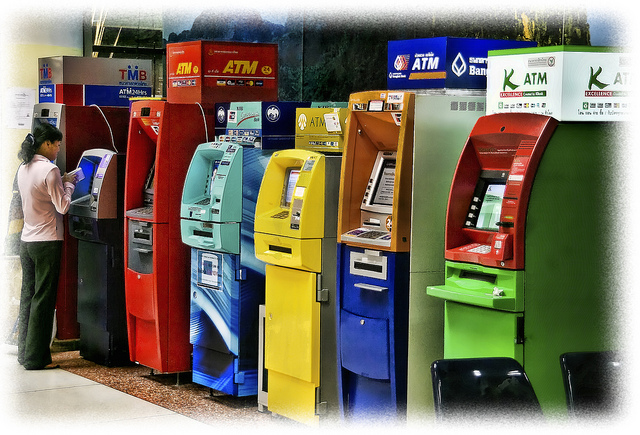
Automated Teller Machines (ATM)

How many of these fun facts did you know about automated bank teller machines (or ATMs, for short)?

1.   Believe it or not, the first cash dispensing machine was invented by Luther George Simjian way back in 1939.   The mechanical dispenser was installed in New York City at the City Bank of New York but was removed after only six months due to lack of customer acceptance.
2.   Simjian later lamented that, “the only people using the machines were a small number of prostitutes and gamblers who didn’t want to deal with tellers face to face.”
3. Simjian had another invention that was much more successful during that era: a simulator that could be used to train aviators in identifying types of aircraft and determining their distance and speed.   During World War II, the U.S. Navy bought more than 2000 of them from Simjian.   The number of ATMs he sold during that same period: 0.
4. The first modern electronic ATM was installed in Enfield Town in North London, United Kingdom in 1967 by Barclays Bank.   Instead of cash, though, the ATM dispensed vouchers.
5. The first free standing electronic ATM was installed in 1969 by Chemical Bank at its branch in Rockville Centre, New York.   This device was the first machine to use the magnetic stripe on plastic cards.
6.   ATMs didn’t begin to proliferate until 1973, when 2,000 of the machines were sold and distributed across the United States.   Not everybody was happy; bankers at the time were concerned about the machine’s price tag: $145,000 (in 2009 dollars).   Today an ATM can be bought for under $3000.
7. Sixty percent of Americans ages 25-34 and 51% ages 25-49 use ATM machines eight times per month, withdrawing an average of $55.00 per transaction.
8. TGIF: The most popular day for ATM use is Friday.   On a related note, night clubs with ATMs end up keeping 70-80% of the money dispensed from their cash machines.
9. The United States currently has more ATMs than any other country — but their numbers are dropping.   The Boston Globe reports that after peaking at 396,000 in 2005, the number of US-based ATMs fell to 360,659 in 2007.
10.   Japan has more ATMs than any other country on a per capita basis.   The next four countries in order: Spain, South Korea, the United States, and Canada.

ShareThis